Monday, November 28, 2011

The Need To Compete............


I've always liked competition.  For the majority of my life I have played team and individual sports such as football and track & field, and competed in skateboarding competitions during my middle school years.  Some people are satisfied with being on a team or entering an event, I was not one of those people.  

Well, at least I never WAS one of those people.  I used to have "win at all costs" attitude.  I took pride in WINNING, just competing wasn't good enough.  I loved playing football, especially through high school and college, and when my team won the passion for the sport grew insurmountable.   When we lost, I was they guy you wanted to avoid at all costs. 

I ran track to improve my conditioning for football.  I threw shot put to work on becoming "more explosive".  I really didn't excel at these activities, but I still competed, mainly against myself.  I put forth tremendous effort to break my times and distances each time I stepped on the track or entered the shot put circle.

I like to think that I've gotten older and wiser and I think I've come to the point where I can be happy with the thrill of competition.  Winning is great, but just competing is something that I miss and look forward to doing in the near future.  

I have decided to enter a couple up coming competitions that are strength / fitness related.  The first one is a race called the Warrior Dash.  It's a crazy 3 mile race with a bunch of insane obstacles.  I'm not a big "distance runner" but I figure 3 miles is okay as long as there is mud and some flaming rocks to jump over.  This race takes place this Saturday, December 3rd, and I'm looking forward to getting muddy!  

The other competition I plan on entering is the Got Total? competition put on by Crossfit Ft. Lauderdale.    Most people know I'm not a Crossfit guy, but this event is a one rep max on standing shoulder press, deadlift, and squat.  These are lifts I'm a big proponent of, and having a chance to see how I do against other lifters seems pretty entertaining.  

At 36, I'm not sure how I fair against some of the more "youthful" lifters, but at least I'll go in swinging.  I think my deadlift will be pretty competitive, I'm hoping for 500, but my squat and shoulder press are just mediocre. Just getting under the bar will get those goosebumps kickin' and revamp the intensity that can only be brought about by laying it on the line.  This event takes place Saturday, December 17th. 

These events couldn't be more different as far as the energy systems that are utilized.  One is primarily endurance and the other is maximal strength.  They both require two things desire and intensity, if you bring all you got, you'll be successful no matter the outcome. 

One of my clients asked me if I'm training any differently for these events.  My response was, "Not Really, I just lift heavy, do sprints, run hills, and jump on things- that type of stuff prepares you for just about anything and makes you more awesome".  

Whether it's a "formal" competition or just competing with myself, I really like pushing my mental and physical abilities to the limit.  Winning a competition against others is awesome, but winning the competition against yourself is priceless.  

Push yourself, compete with yourself, and dominate the person staring back at you in the mirror. It's about time to start bettering your best...................

Tuesday, November 8, 2011

The Best Workout & Diet Plan EVER!!!!


There is new "ground breaking" workout and eating plan that will help you shed fat, get ripped, increase your strength and improve endurance.  Of course, anything NEW and "ground breaking" definitely is worth a try, because programs and eating plans of the past really aren't good enough.


The workout is so productive because of a process called "Muscle Thermodynamic Activation".  This principle was brought about by Eastern Bloc countries when athletes were cutting weight for World Wide competitions and had very little time to reduce body fat.

Muscle Thermodynamic Activation (MTA) is a process in which your muscles release an abundance of ATP and Creatine Phosphate and raise you body temperature to increase fat burning.   This process will continue to burn fat for 24-48 hours post workout.  MTA  has been shown to increase EPOC by 413% which is basically a full on fat burning blitz! 

An example would be to perform rapid, quick movements for 5-10 seconds after each set of resistance exercise.  So after a set of squats jump up and down and shake your arms vigorously for around 7 seconds.  If you are seeking the ultimate body fat reduction technique,  Muscle Thermodynamic Activation is kicked in to high gear by "shaking" your muscles and other body tissue.  Perform a "shake" similar to a wet dog trying to dry off.

If you really want a thermogenic effect, after each set of resistance exercise - shake your body violently for around 10 seconds.  Trust me, you'll feel the fat burning from your stomach, glutes, and thighs like never before.

Now for the ground breaking nutrition information that was keep under lock and key until a world renowned exercise physiologist and professor of human biology leaked this earth shattering secret.

The combination of 2 specific foods can give you a huge burst of energy and basically stop your body from storing body fat because of the synergistic enzymes that are released.  When combined with Muscle Thermodynamic Activation the body fat / weight loss results have been unprecedented.

These two foods are radish and beef jerky.  When eaten together they create an inferno of fat burning nutrients that can get you shredded in no time!  The texture of the radish and the amino acid content of the beef jerky create an unseen increase in metabolic rate.

It's a simple plan, just eat radish and beef jerky for breakfast and lunch and have a normal, sensible dinner and in 10-14 days you will need to buy a whole new wardrobe!

Okay, okay- If you're still reading this I give you credit.  Obviously I was just giving you a ride on the BS train that well educated adults actually would consider believing. As crazy as it seems there are some people out there that will follow this advice, or something very similar because the vast majority of our population is always searching for the "new and best" way to lose weight.

It shouldn't be that complicated.  Eat quality food, control your portions, and commit to an exercise program. Eat lean protein, lots of veggies, some fruit, and healthy (natural) fats.  Lift weight, do sprints, move more throughout the day and BE CONSISTENT!

Getting in shape shouldn't be a 2,4, or 8 week commitment. Make it a lifestyle.  Start setting your goals a couple years from now, not 6 weeks from now.  If you are 15 lbs. lighter in 6 weeks but 40lbs. heavier in 2 years what did you really accomplish?

Don't fall for gimmicks.  Don't buy into "rapid results" programs.  Make it a long term commitment to be leaner, stronger and healthier.  Improve the quality of your life from here on out, not just for 12 weeks.  Take the appropriate steps to make some positive changes, stick with your plan, and live healthy and be happy- that's what "being in shape" should be about.......

Friday, October 21, 2011

How do you measure progress?


Most people begin an exercise/diet plan to improve their physical condition, improve health, and decrease stress.  Some people just hit the gym to look good naked and really don't care about their long term health or the way they move, but they still want to make progress in the gym and more importantly noticeable progress in the mirror.

Whether your goal is to improve your lipid profile or compete in "Flex-Off 2011", there are ways to monitor your progress that will help determine if what your are currently doing is working for YOU.  

If you want to improve overall health, blood work, and body weight/composition - going to a physician and getting a full panel of tests done as well as a body composition measurement (skin caliper, physiograph, underwater weighing, bodpod) would be a very efficient start.  Getting an accurate reading of your blood pressure and resting heart rate would also be an important part in gathering some starting statistics.

You should be logging your food, calories, and nutrients as well as keep an exercise journal.  If you don't see any positive changes after 8-12 weeks it might be time to alter you food choices and exercise selection.  If you are 100% committed to achieving results, and don't cheat on your diet or skip or slack in your workouts you will see results.  But where will you see results, the scale, caliper, mirror, loose fitting jeans?  All of those will be sufficient forms of measurement.  However for your cholesterol, vitamin mineral deficiences, and hormone levels, more blood work is needed. 

If you just want to look good in a pair of board shorts or a bikini, a mirror isn't the only way to evaluate progress.  I take it that you are already fairly lean, so skin caliper testing done every 7-10 days will help determine if you are on the right track to a banging beach body.  Keeping track of what you are doing in the gym and what you are putting in your pie hole are extremely important.  If your results aren't headed in the right direction you might need to add protein, cut the carbs, increase the fat or decrease your calories.  It is also necessary to keep track of your lifting/cardio sessions.  You might be doing too much cardio, and not lifting a sufficient amount of weight - which is usually the case.
One of my all time favorite "core" exercises! 
My opinion is that if you train to get stronger, everything else will fall into place.  Strength is one of the easiest, most reliable things to measure.  You can evaluate your progress each time you enter the gym.  Strength can be evaluated by dumbbells, a barbell, or even your own body weight.  Chances are that if you improve the amount of pull-ups you can do and increase the amount of weight you front squat, you are going to look better naked.  I you can do more push-ups, that very well could be the result of reducing some unwanted body weight.  
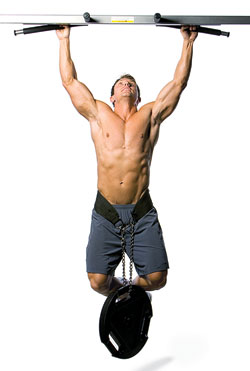
Chances are that if you can do weighted pull ups,  your pretty darn lean!
As far as overall health, increasing the amount of weight on each exercise will have a positive effect on structural stability which could lead to better movement efficiency.   Increasing the volume of your lifting sessions will also have positive impact on bone density.  When better food choices are thrown into the mix, it's a win-win for improvements in blood work. 

A good way to start measuring your progress when it comes to gaining strength is to get an idea of how much weight/reps you can perform in the following movements. (if not limited by injury) 
-Amount of total push ups, pull ups/inverted rows you can perform. (timed for a minute if needed)  
-Amount of weight you can perform on a front squat for a 3 rep max. 
-Amount of weight you can deadlift for a 1 rep max. 
-Amount of weight on a bench press/overhead press for a 3 rep max.
-I'm not a big fan if distance running, but timing yourself in a mile run can be a decent measurement for cardiorespiratory endurance.
-If you prefer shorter distances you can do some intervals on the track, run 100 meters in a specific time frame (12-20 seconds) and rest 45 seconds,  run as many as you can without exceeding your rest time.  Once you fatigue, the number of 100's you can complete will be your measurement, try to improve on that each week.
-After 6-8 weeks of intense training, it's time to retest.  

If your eating is on track, once these lifts/movement/exercises  are increased you will be one step closer to achieving measurable, efficient progress in the gym or on the track and of course- the mirror.  Don't just settle for going to the gym for a workout, actually start TRAINING to get STRONG- everything else will fall in place.    

Thursday, October 6, 2011

The Smith Machine - A waste of valuable gym space?


Over the years I've omitted certain exercises, machines, or movements for various reasons.  The main reason I've taken a stance in avoiding certain "gym things" is safety and movement efficiency.  A VERY close second reason would be the BENEFIT of an exercise. Some exercises are extremely beneficial, but not everybody has the stability and mobility to perform them effectively, which could lead to injury.

If a client can't move efficiently, such as not being able to perform a squat or lunge properly. Or if they can't perform a  push up or row variation with proper body alignment and shoulder function, we'll mainly work on activating certain muscles and working up to the full range of motion with the above movements.

I didn't always train that way, I used to just run clients though various exercises and machines at the gym and try to make them sweaty and sore.  Yes, I was a moron.

Of all the exercises  I see people performing at the gym with major movement dysfunction, the Smith Machine would rank #1.

Some of the problems I see with the Smith Machine:

-A fixed plane of motion.  The bar slides up and down a guided path and for most exercises such as squats and bench press, and our most of the time this can lead to shoulder, knee, and lower back issues.  Our bodies should operate on a more "functional path".  This guided path takes the lower back out of the equation during squats and places more sheer force on the patella.  During the bench press, the fixed path can take all of the shoulder stabilization out of the exercise, which would be avoiding one of the benefits of the exercise- on purpose.
This causes pain in MY shoulders...... 

-False sense of resistance.  Whether you are providing more force with your right or left arm (or leg), the bar will still travel in an even path.  Using free weights such as an Olympic Bar or Dumbbells, it is extremely noticeable which limb is providing more force.

-Its a trainer-no brainer.   A lot of trainers who are uneducated or just don't feel like taking time to teach an actually "free weight" movement will just stick they clients on the Smith Machine because "it's easy".

-Misrepresentation of the actual load lifted.  If you push the bar in a forward / backward motion while moving the bar upward, you are using the guide track to help with the resistance.  There are some gym goers who bench two 45lb. plates on each side and claim to bench 225lbs.  Once they step outside of fairly tail land and get on a real bench,  they'll get a 225lb. bar to the chest that doesn't budge.

When I see all of the money gyms waste on these machines, it amazes me.  You could get 2 or 3 power/squat racks for the price of one Smith Machine- but you need employees that are capable of teaching certain exercises out of those racks, which is hard to find now a days.
This dude is also using a "sissy pad" - awfulness! 
The Smith Machine does have some uses in my book.  It's a great place to strap the TRX or a great place to anchor resistance bands.  For certain cases, such as bodybuilding, it is adequate for movements solely designed for hypertrophy.  

Most people just want to get leaner, get in better physical condition, and move more efficiently and pain free, the Smith Machine is far from the  best tool for accomplishing those things.

The last thing regarding the Smith, that I find pretty humorous is listening to a personal trainer brag about how they are an expert at functional training and then seeing their clients perform 1/4 rep squats using that damn machine.

Next time you're in the gym head to the squat rack or dumbbell area, let your body do the work instead of some lame ass machine.....

Wednesday, September 28, 2011

Group X = A breeding ground for inefficient movement patterns???


Every now and then when I walk by one of the Group X classes going on in the gym and I'll check it out for a couple minutes.  No, not to see if there are any hotties in spandex, but I get a kick out of some of the movement patterns and flawed technique that I see from some of of the attendees.

Actually, there are times when I feel sick to my stomach and my knees and back hurt from the awfulness that I see being demonstrated.

Most of the time these classes are packed with 30-50 people and most of the classes I've observed the majority of attendees move worse than a baby cow walking on ice.  Once and a while I'll be tempted to bust through the door and say "You call that a F'in squat -get lower!".  Of course, I am kidding.  I do really feel bad for the people attending some of these Boot Camps and Cardio Pump classes - they don't know what their doing is wrong, and 99% of the time the instructor won't take the time to correct them.

I understand that getting people to move is good, and if someone has fun while exercising- that's great.  But, when 90% of the class can't do a proper squat and they are doing 50-100 repetitions of an exercise, that's just asinine.  All that is going to be accomplished is a little sweat, a minuscule caloric burn, and a faulty movement pattern engraved in a persons mind.
This is actually good compared to some of the crap that I have seen! 

I think it would be a little more intelligent, and of course, more time consuming to teach a person HOW to do an exercise before you have them perform endless repetitions with horrible form.  It's not only squats, but push ups and lunges as well- the basic exercises are getting butchered in these so-called fitness classes.

I see people performing lunges with rounded backs and excessive forward lean, not to mention horrible foot placement.  Push-ups aren't any better, I've witness camel back syndrome and have seen hands placed in a variety of strange locations. 
I love push-ups, but make sure they are done right!
It goes on at boot camps  and group training facilities as well, exercises are just are not being TAUGHT.  They are being TOLD.  When you tell someone to do something and don't correct them if it's being performed wrong - that's just plain irresponsible as a fitness professional.

If a person performs and exercise with horrible technique day in and day out, it is an extremely long process to correct their deviations and deficiencies.  Exercise should develop healthy habits and movements not the opposite.  It's pretty clear why several people that I've evaluated before training sessions complain of knee, back, and shoulder pain.  Most of them demonstrate horrible form when performing a lunge, squat, or push up.

A solution to this problem would be having anyone interested in attending a Group X class or a Boot camp go through a screening process in a small group setting to evaluate and teach proper exercise technique.
Getting to proper depth is a challenge for most people!


I would honestly rather have someone perform 3 sets of 5 repetitions of proper squat rather than 100 squats with terrible technique.  One of my goal when training someone is to help them move more efficiently.  When a person demonstrates a movement that could lead to an "overuse" injury. When a client is beginning my program I look at the movement pattern to evaluate tightness/weaknesses.  I also structure their lifting sessions with the priority of correcting those issues.
Pop Quiz- Which athlete has better form???
One of the rebuttals I've heard from some of the attendees of a Group X class was,  "That class really made my legs burn, it had to be good".  In all honestly, just because an exercise "burns" or makes you sore doesn't necessarily mean that's a good thing.

Moving correctly is a good thing.  I know not everyone can afford to hire a personal trainer, and it's really hard to find a trainer who knows what their doing (most of them are salesman).  However, seeking someones help with knowledge of biomechanics will help identity some weaknesses and deviations in movement patterns that should be corrected would be really beneficial.   Once you can move better, your exercise sessions will be more efficient.

I'm not saying every Group X class or Boot Camp class is a waste time (a lot of them are), just remember why you are exercising- to improve your health, right?  It's pretty hard to feel healthy with a jacked up back, a sore shoulder, and knee pain 24/7.   Learn to move better, your body will thank you.

Wednesday, September 21, 2011

It's One Thing....


For most people, achieving the desired results they want from a diet / exercise program comes down to one thing.  That ONE thing is something that you need to start doing or stop doing to get your body and overall health in better physical condition.

Of course that ONE thing leads to a bunch of other things that snowball and create a bigger roadblock on your path to success.  With myself, clients, and friends it's really not too difficult to identity what ONE thing or ONE change needs to be made.

A couple of my clients are perfect examples.  One of my clients really enjoys wine.  Sometimes that enjoyment can be more than a glass or two and when that happens, clean eating goes out the window.  She'll tell me, "After one glass I'll eat really good, but after 3 - I start to crave chips, pasta, or chocolate".  On the nights she has NO wine her nutrition is right on track and her training sessions are more intense.

Another client of mine is in great cardiovascular shape.  He has phenomenal muscular endurance, however he is lacking the all important strength component.  Things like chin-ups and compound lower body exercises with a decent amount of weight are really a challenge.  It's not a real surprise that he has a history of lower back and shoulder issues.  The ONE thing that he needs to improve is STRENGTH.   Now that we are focusing on getting stronger rather than "circuit/metabolic" based workouts, his structural deficiencies are starting to subside and his training sessions are much more beneficial.

Some friends I know crave bread or snack foods.  If they go to a restaurant and there is bread on the table or chips and salsa, the word indulge comes to mind.  Once they load up on the carbs, grease, and salt, the attitude is "Oh well, might as well get something bad since I've already gotten off track".

We can all sit back and pinpoint ONE thing that we could start doing or stop doing for a few weeks and we would see significant physical changes.

Could you:

-Focus on getting stronger, and actually STRENGTH TRAIN?
-Maybe add in a little cardio/interval work to your program?
-Perform single leg work and identity some inefficient movement patterns?
-Start doing lower body resistance training instead of Bench Pressing 3 days a week?
-Begin your upper body sessions with pulling instead of pushing exercises?
-Start getting to sleep an hour or two earlier?

Could you avoid:
-Pouring that glass of wine (or 3) with dinner every night?
-Chowing down on that bread and butter that's gonna add 800 calories to your dinner?
-Going to the gym and heading straight to the elliptical?
-Going to happy hour and actually make it to the gym on a Friday?

You hear it all the time.

If I just didn't eat _______ I'd be a lot leaner.........DUH?
If I just did some flexibility/mobility work my back would feel a lot better......REALLY?
If I just didn't drink beer, I'd be able to lose 10lbs?  SHOCKER

You owe it to yourself to walk around healthier and in better physical condition, don't let something hold you back.  Especially if it's just ONE thing.

Tuesday, September 13, 2011

Aren't results what really matter???


There is so much criticism and opposing views in the strength/conditioning/fitness world that the internet has turned into a keyboard battle ground.  I know that some internet commandos don't know anything about getting stronger, and when it comes to anatomy, they don't know their ass from their elbow.  However, there are some real knowledgeable professionals that tend to disagree as well, and do so rather bluntly.

I'm all for a good session of constructive criticism.  I think I've learned more from doing stuff wrong than doing things the right way.  It is a little wake up call to your ego when you have a coach or trainer you admire basically call some exercises you prescribe as "a waste of time" or "too dangerous to teach, risk vs. reward".

It's important to accept others professional views. It is also important to spend time researching and gaining knowledge to determine why some "experts" feel the way they do about an exercise, program design, or training structure. The more knowledge you gain the more you will stand behind your training philosophy, or make changes where they are needed to get more efficient results. You don't have to agree with everything you read, but at least have knowledge on why you are doing an exercise / avoiding an exercise and understand which situations would be appropriate for various training programs.

This can also be applied to cardiovascular/fat loss protocols as well as discussing various diets.

Some industry leaders bash steady state cardio, and some get amazing results for their clients performing  5 / 45 min. sessions of incline walking a week.  Some people feel that interval training is the way to go for fat loss, others feel that "metabolic conditioning" is the most effective fat burning strategy.  Let's not even get started with the fasted cardio debate.

Discussing nutrition is even more lopsided.  Now there is such a big following of Intermittent Fasting, and the IF crowd is ridiculing the 6 meals a day crowd.  Then there are people that love to criticize anyone who mentions the term "Paleo", it's like the way you choose to eat is like the high school crowd you hung-out with.  Instead of the Jocks, Burn-outs, and Nerds- you have the IF'ers, Paleo's, and 6SM's (six small meals).

In the end, aren't results the only thing that matters.  Whether my athlete squats on both legs or performs single leg movements, as long as they get stronger and are more productive in their sport- I've been an effective coach.  If my athletes do Olympic lifts, or if I choose to focus on plyometric exercises for power production, as long as they remain healthy and perform more explosively, I have helped them achieve their desired result.

When it comes to Fat Loss / Cardio / Nutrition, as long as a client is getting leaner while retaining or even gaining lean body mass, does it matter if they are eating 3, 4, or 5 times a day?  Or if they are walking on a treadmill instead of performing intervals for their cardio based activity?  Or if they are carb cycling or following a ketogenic diet?

What matters is results.  I think some people just get all warm and fuzzy inside when they ridicule an article or blog post.  If another trainer or coach is getting measurable, desired results with their athletes or clients - don't they deserve enough respect to hear them out?  Like I said, we don't all have to agree, just understand why you disagree.  As far as getting someone stronger, leaner, and more muscular - there's more than one way to skin a cat, and we should spend more time understanding and applying various strategies than criticizing them.